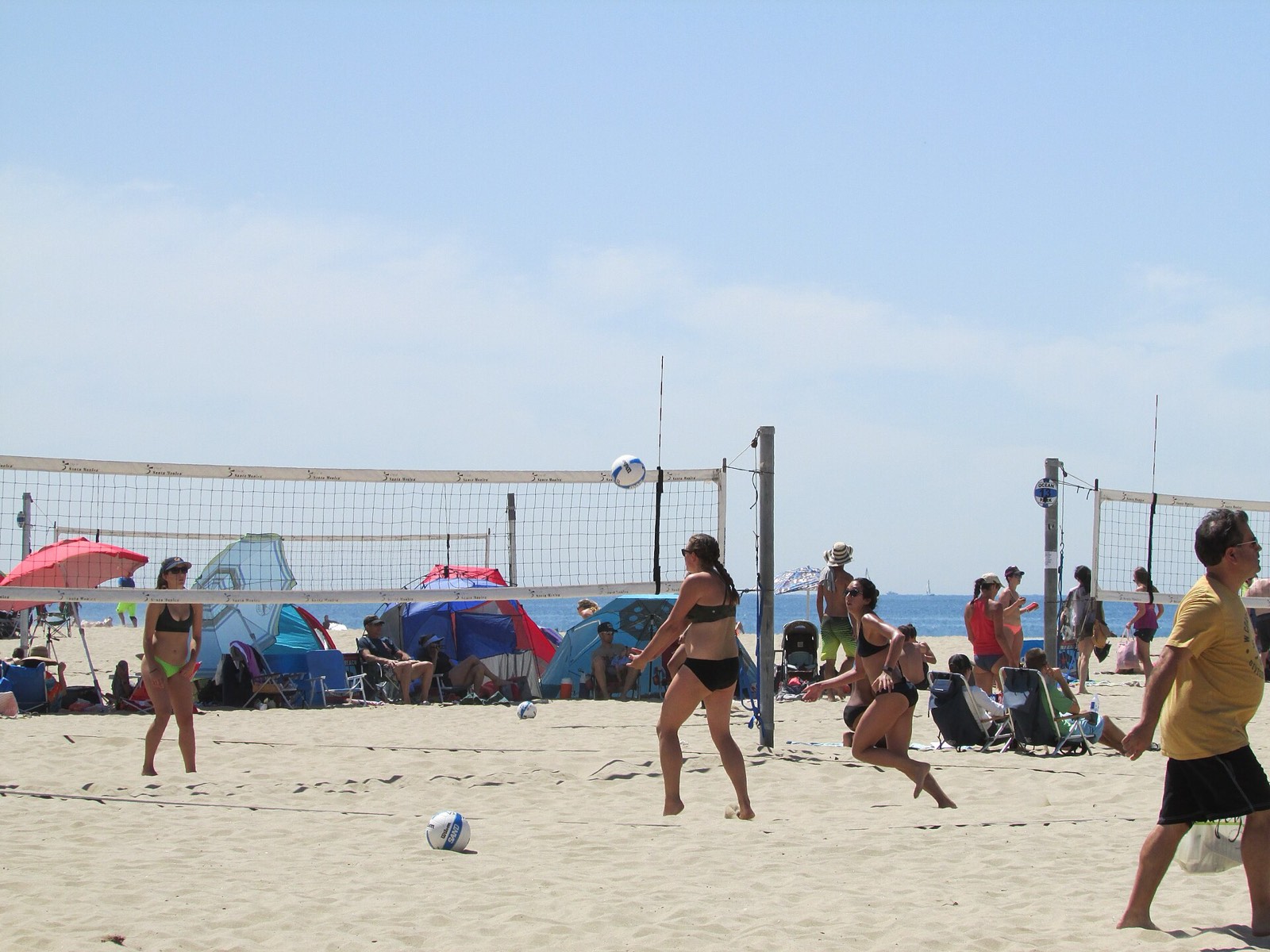
Above: a women's game on Santa Monica beach, where the two-player sport grew up (photo CC BY 2.0). On a hot afternoon at Pier 25 in Tribeca, you can watch New Yorkers in office-tan bodies dive across imported sand while ferries slide past on the Hudson. It's a scene that would have puzzled William G. Morgan, who designed volleyball to be played indoors in a Massachusetts winter. But the beach version has become one of the sport's great success stories, and it started on the other coast.
Sun, sand and a net
People were playing volleyball on beaches almost as soon as the game existed. There are reports from Hawaii, around the Outrigger Canoe Club in Waikiki, in the 1910s, and from the beaches of France and Brazil in the 1920s. But the version we know, as a serious sport with its own culture, grew up in Southern California.
At State Beach in Santa Monica, players began putting up nets in the 1920s, often playing six-a-side as they would indoors. Around 1930, the story goes, a few players found themselves short of teammates and tried playing two against two. They discovered that the smaller teams made the game more demanding and more fun: every player had to pass, set and hit. Two-player doubles slowly became the beach standard.
The Depression-era beach
Through the 1930s and after the war, beach volleyball was a cheap pleasure. It required no club fees, no gym and almost no equipment. Tournaments began appearing along the California coast from the late 1940s, with prizes that were more likely to be a crate of soda than cash. The players were mostly lifeguards, students, surfers and people who simply never wanted to leave the beach.
For decades, the prize for winning a beach tournament was the right to play the next one.
The 1970s boom
In the 1960s and 70s, beach volleyball rode the wave of California youth culture. Crowds grew, television started to notice, and sponsors arrived. A brewery-sponsored world championship event at State Beach in the mid-1970s is often remembered for drawing tens of thousands of spectators, a sign that the sport had become a genuine spectacle.
Money brought tension. Players felt promoters were making a fortune while they split small purses. In 1983 they formed the Association of Volleyball Professionals (AVP) to run their own tour. Through the late 1980s and 90s the AVP grew into a proper professional circuit, with big-name sponsors and players who could finally make a living in the sand.
Atlanta 1996: Olympic gold in the sand
The FIVB launched an international beach tour in the late 1980s, and beach volleyball was a demonstration event at the 1992 Barcelona Olympics. Four years later, at the 1996 Atlanta Games, it became a full Olympic medal sport. The men's gold went to Americans Karch Kiraly and Kent Steffes. For Kiraly, who had already won indoor gold with the US team in 1984 and 1988, it was a unique treble. The first women's champions were Brazil's Jackie Silva and Sandra Pires, a reminder that Brazil had built its own beach volleyball culture on the sands of Rio.
The May-Treanor and Walsh Jennings era
No partnership did more to make beach volleyball mainstream television than Misty May-Treanor and Kerri Walsh Jennings. The Americans won Olympic gold three times in a row: Athens 2004, Beijing 2008 and London 2012. They became household names in a way few volleyball players ever had. A generation of American girls took up the sport because of them.
Beach volleyball in New York
New York may not have California's weather, but it has a lively beach scene. Players gather at Rockaway Beach and Coney Island in summer and on the sand courts at Pier 25 in Hudson River Park, and there are leagues across the boroughs, many of them social and mixed. It's one of the easiest ways to meet people in the city, as long as you don't mind sand in places sand shouldn't be.
Looking ahead to Los Angeles
The 2028 Olympic Games return to Los Angeles, close to where it all began, and beach volleyball will once again be one of the hottest tickets. For a game born from a few people who couldn't find enough teammates on a Santa Monica afternoon, that's quite a journey.