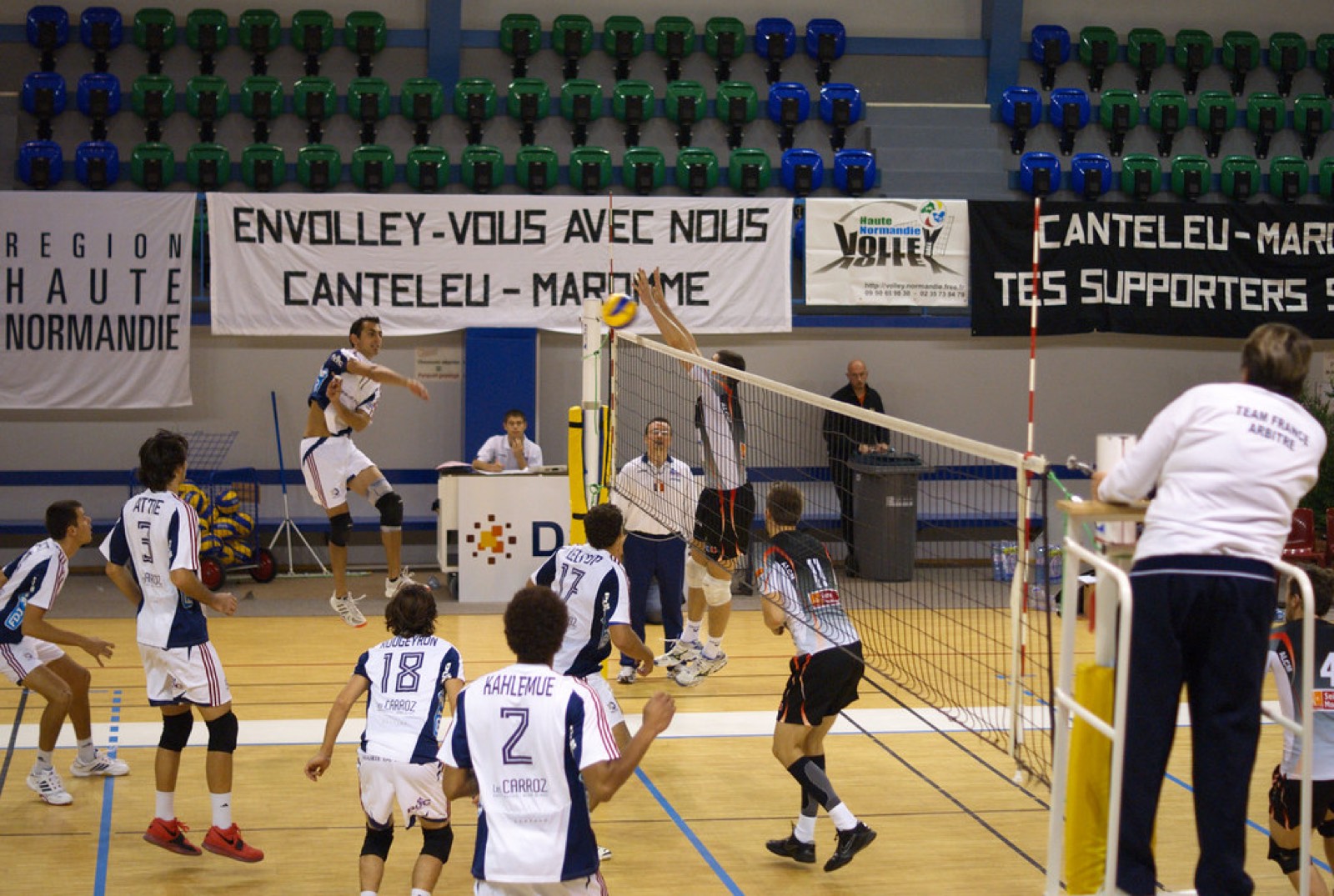
Above: an attack at the net in a French club match (photo: zigazou76, CC BY 2.0). If you watched a volleyball match from 1985 and one from 2025 back to back, you might think they were different sports. The older one would feel slow and stop-start, with long stretches where nobody scored. The newer one would feel like a firework display: short, explosive rallies, every point counting, and a defender in a different-coloured shirt diving everywhere. The difference isn't just fitter athletes. It's a set of rule changes, most of them made in a single busy decade.
The problem: side-out scoring
For most of the twentieth century, volleyball used side-out scoring. You could only win a point when your team was serving. If the receiving team won the rally, they won nothing but the right to serve. Games went to 15 points, but because so many rallies produced no point at all, matches could drag on for hours. Television hated it. Schedules were impossible, and a dull stretch of side-outs was a good time to change the channel.
Rally-point scoring
The fix was simple: make every rally count. Under rally-point scoring, the team that wins a rally scores a point, whoever served. To keep matches from getting too short, sets were extended to 25 points (with a two-point margin), and the deciding fifth set to 15. The FIVB adopted the system at the end of the 1990s, and the 2000 Sydney Olympics were played under it. American high school and college volleyball followed within a few years.
The effect was dramatic. Match lengths became far more predictable, every rally carried tension, and comebacks became more exciting because no point was "free." Some old-timers grumbled that tactical serving mattered less. Almost nobody wants to go back.
Under side-out scoring, half the rallies didn't matter. Now every single one does.
The libero
Around the same time, volleyball had a different problem: the game was being taken over by giants. Attacking had become so powerful that rallies ended almost instantly, and shorter players, often the best passers and defenders, were being squeezed out of top-level teams.
The answer was the libero (Italian for "free"), introduced at international level in 1998. The libero is a defensive specialist who:
- wears a shirt of a contrasting colour so referees can spot them;
- can replace any back-row player without counting as a normal substitution;
- cannot attack the ball from above the height of the net, and cannot block;
- usually comes in for the middle blockers when they rotate to the back row.
The libero made rallies longer and defence more spectacular, and gave smaller, quicker players a route to the top level. Want to see how it fits into a rotation? Try the libero button on our Rotation Coach.
Smaller changes, big effects
- Let serves: a serve that clips the net and goes over used to be a fault. Now it's live, which removed a lot of fussy whistles.
- Any part of the body: the old rules restricted which parts of the body could legally touch the ball. Modern rules allow contact with any part of the body, including the feet.
- Gentler handling calls: referees became more tolerant of the first contact, especially on hard-driven balls, so defenders can dig with more freedom.
- Video challenges: during the 2010s, top competitions introduced video challenge systems so coaches can contest line calls, net touches and touches off the block.
- Coloured balls and shorter breaks: made for television, but loved by fans in the arena too.
Where the game is heading
Volleyball keeps experimenting. Leagues have tried shorter formats, serve clocks and new substitution rules. In the United States the professional landscape has changed fast. The 2026 season brought a unified women's league, Major League Volleyball, formed by merging two rival leagues, alongside League One Volleyball and Athletes Unlimited. College volleyball has become one of the most-watched women's sports in the country. And in 2028 the Olympic Games come to Los Angeles, close to the beaches where the two-player game grew up.
Meanwhile, the international game is at a high point. Italy won both the men's and women's World Championships in 2025, and new powers keep rising. It's a long way from a tennis net in a Holyoke gym, but you can still see Morgan's three ideas in every match: a net, no catching, and the joy of keeping the ball alive.