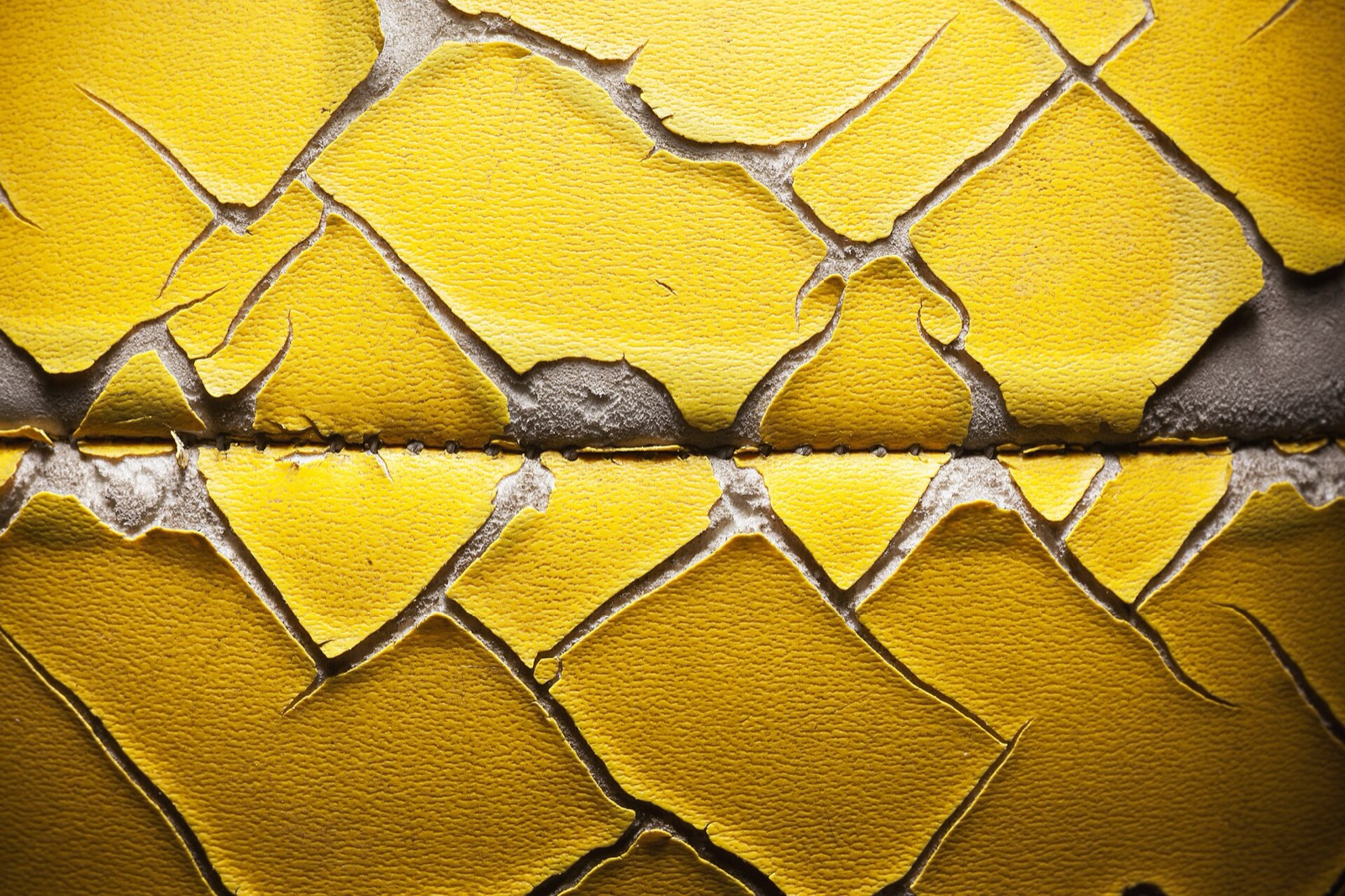
Above: a close look at a modern match ball (photo: Dejan Krsmanovic, CC BY 2.0). Pick up a good volleyball and squeeze it. It gives a little, then pushes back evenly wherever you press. Toss it up and it hangs in the air a fraction longer than you'd expect. Hit it hard and it doesn't sting the way you'd think. None of that is an accident. A modern match ball is a carefully balanced object, and it took more than a century to get there.
1895: nothing worked
When William G. Morgan invented the game (see Mintonette), the right ball didn't exist. A basketball bladder on its own was too light and floaty. A full basketball was too heavy to hit comfortably with an open hand. Morgan asked A.G. Spalding & Bros. to make something specific. Their answer, a leather case stitched over a rubber bladder, became the first purpose-built volleyball. Spalding was selling official balls within a few years.
Those early balls had problems of their own. Leather soaked up sweat and water, got heavy and lost its shape. A ball that started a game firm could end it soggy. Laces and stitching made the surface uneven, and it could swerve unpredictably.
The three layers of a modern ball
Today's indoor match balls are built from the inside out in three main layers:
- The bladder. An airtight inner balloon, usually made of butyl rubber, which holds air for a long time, or natural latex, which feels softer but loses air faster. A valve lets you pump it up.
- The carcass or winding. Nylon or polyester thread is wound around the inflated bladder, often by machine, thousands of times, in a crisscross pattern. Sometimes a layer of fabric is used instead or as well. This layer keeps the ball perfectly round and stops it stretching when it's hit hard.
- The cover. Panels of synthetic leather, usually polyurethane or microfiber, are glued (laminated) or stitched onto the carcass. The cover controls grip, feel and how the ball moves through the air.
A good volleyball is basically a balloon, wrapped in thread, wearing a carefully tailored jacket.
How a ball is put together
The process varies by maker, but a typical factory sequence looks something like this:
- The bladder is moulded, cured and tested for air leaks, sometimes by inflating it and leaving it for days.
- The inflated bladder goes onto a winding machine, which wraps it evenly in thread.
- Cover material is printed with logos and colours, then die-cut into panels with exact shapes.
- Panels are glued to the carcass under heat and pressure, or hand-stitched for some recreational balls. Laminated match balls tend to hold their shape better and soak up less water.
- Each finished ball is inflated, weighed, measured and checked for roundness and bounce.
The numbers that make a ball "official"
The FIVB sets the specifications for international play. Here are the commonly published figures:
| Spec | Indoor ball | Beach ball |
|---|---|---|
| Circumference | 65–67 cm | 66–68 cm |
| Weight | 260–280 g | 260–280 g |
| Internal pressure | 0.30–0.325 kg/cm² | 0.175–0.225 kg/cm² |
| Feel | Firm, fast | Softer, slightly bigger, floats more |
Beach balls are a touch bigger and inflated to a lower pressure, so they're softer, slower and easier to dig on a windy day. Many are stitched rather than glued, and built to cope with sun, sand and water.
Colour and dimples
For most of the twentieth century, a volleyball was simply white. In the late 1990s the FIVB approved coloured balls for international competition, largely so the ball would show up better on television. The yellow-and-blue design became instantly recognisable worldwide.
The biggest recent change is in the cover. Instead of the traditional 18 rectangular panels, Mikasa's V200W match ball, adopted for international competition from 2019, uses just eight panels with a dimpled surface, a bit like a golf ball. The idea is to make the ball fly more steadily and give players more consistent contact. Players argued about it, as players always do about new balls, but it's now standard on the world stage. Rival makers such as Molten produce the official balls for many American and collegiate competitions.
Choosing a ball yourself
If you're buying one for the park or the gym, a few tips:
- Buy an indoor ball for indoor courts and a beach ball for sand. The difference is noticeable.
- A laminated synthetic-leather ball feels better than a cheap rubber one and is gentler on your forearms.
- Check the recommended pressure printed near the valve, and use a gauge. Most balls are pumped too hard.
- Store it out of the sun and away from heaters, which dry out the cover.