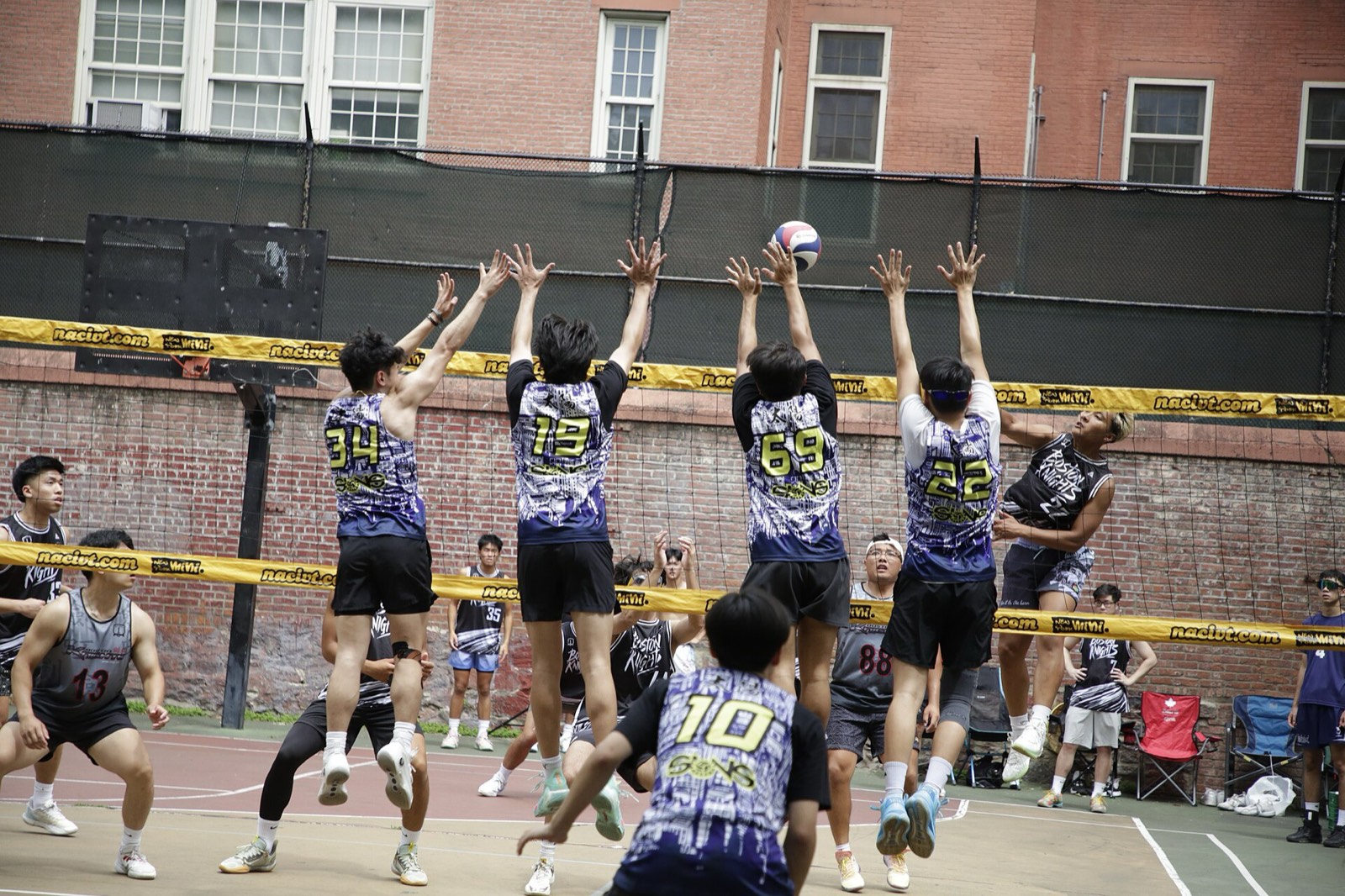
Above: nine-man volleyball in New York's Chinatown, 2025 (Wikimedia Commons). Walk through Manhattan's Chinatown on a summer weekend and you might hear it before you see it: the slap of a ball, a shout in Cantonese or English, a burst of laughter from a crowd on the sidewalk. Somewhere between the restaurants and the playgrounds, nine men stand in rows on hot asphalt, playing a version of volleyball most Americans have never seen. It's called nine-man, and it's one of New York's quietest sporting treasures.
A game that came with the immigrants
Volleyball reached China early in the twentieth century through YMCA instructors, as we describe in our story on the YMCA. In parts of southern China, especially the Toisan (Taishan) region of Guangdong province, a nine-player version became popular. Toisan was also the home region of a huge share of the early Chinese immigrants to the United States and Canada.
Those immigrants arrived in a hostile country. The Chinese Exclusion Act of 1882 severely restricted immigration and kept Chinese communities small, overwhelmingly male and isolated for decades. Many men worked long hours in laundries and restaurants, often six or seven days a week. Nine-man volleyball, which could be played in an alley, on a rooftop or in a parking lot, gave them a rare break, a way to compete, and a way to connect with men from other cities.
For a community that was kept out, the game was a way of staying together.
How nine-man works
If you know regular indoor volleyball, nine-man will feel familiar and strange at the same time:
- Nine players stand in three rows of three: front, middle and back.
- No rotation. Players keep fixed positions and specialise. Front-row players are attackers and blockers; the back row covers the deep court.
- The net is in play. In nine-man, the ball may hit the net during a rally and the action continues, and players can make plays off the net that would be faults in standard volleyball.
- A bigger court and a slightly different rhythm, with a lot of emphasis on quick attacks and clever placement.
The serve, the three touches and the basic idea of keeping the ball off your floor are the same. Everything else has evolved separately for a century.

The NACIVT
The heart of the nine-man world is the North American Chinese Invitational Volleyball Tournament, or NACIVT. It's held every Labor Day weekend and rotates between host cities with strong Chinatown communities: New York, Boston, Washington, Toronto, Montreal, San Francisco and others. Teams from across the US and Canada travel to play, and the weekend doubles as a reunion and festival.
The tournament has been running since the first half of the twentieth century, and its numbering tells the story. New York's organisers billed a recent edition as the 80th NACIVT, and the 2026 tournament, held in Montreal's Chinatown on September 5–7, was announced as the 81st. That makes it one of the longest-running community sporting events in North America.
Eligibility is part of the tradition, and part of the debate. The tournament has long had rules limiting rosters to players of Chinese and other Asian heritage, a rule rooted in the game's history as a space created by and for a marginalised community. It's argued about inside and outside the community, and it changes from time to time.
New York's scene
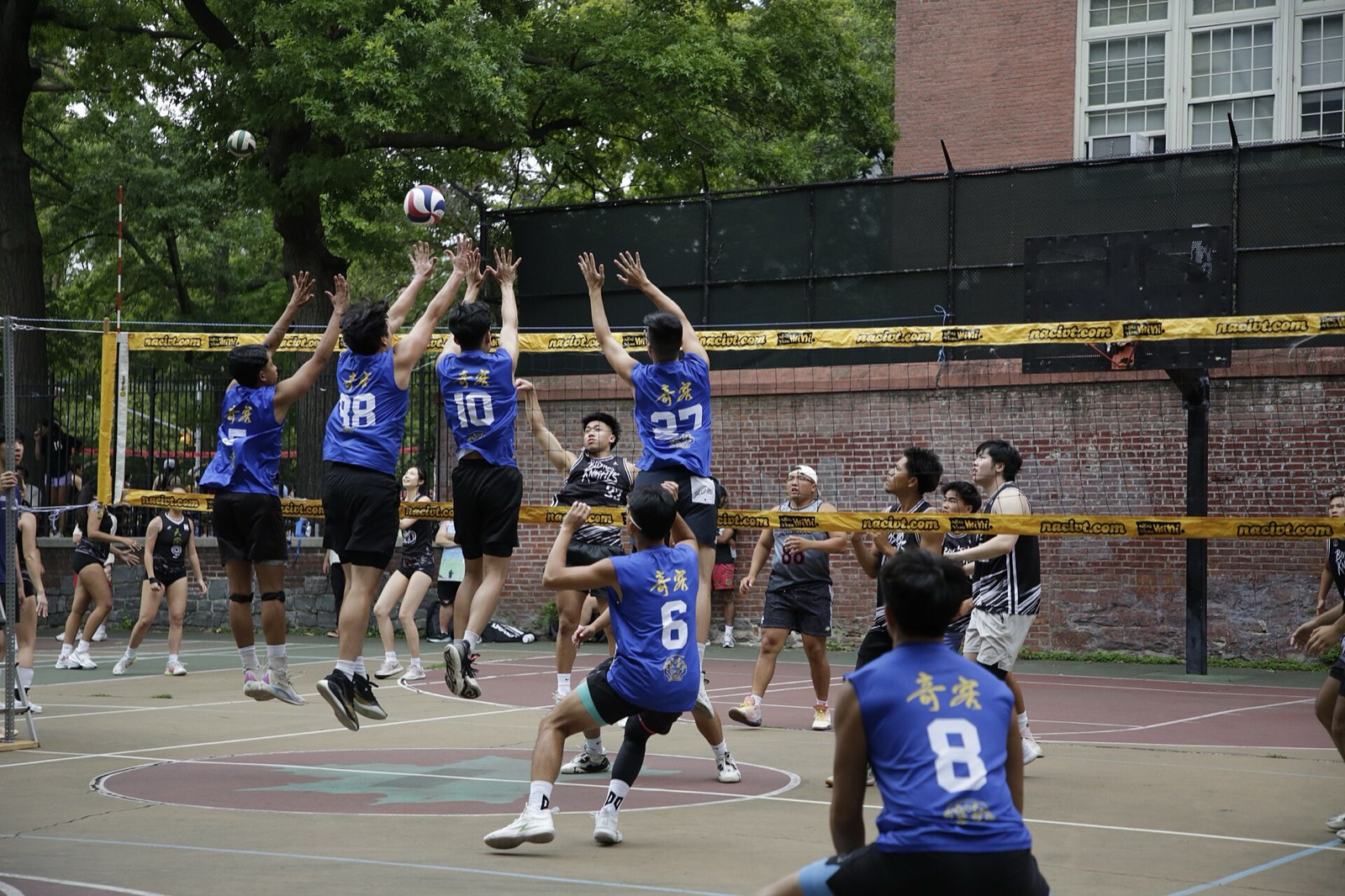
New York has one of the deepest nine-man communities on the continent. Clubs practise in school gyms, church halls and public parks around Manhattan, Brooklyn and Queens. Summer tournaments on the Lower East Side have drawn crowds of spectators, and local news outlets have covered games played in the shadow of tenement buildings. For many players, the club is a social anchor: older players coach younger ones, families come to watch, and the post-game meal is as important as the result.
The 2014 documentary 9-Man, directed by Ursula Liang, brought the game to a wider audience, following teams preparing for the tournament and exploring what the sport means to Chinese American identity. If you want to understand the game's emotional pull, it's the place to start.
Why it matters
Nine-man volleyball is a reminder that sports don't just spread. They get adopted, reshaped and protected by the people who play them. A game that came from a YMCA idea in Massachusetts, travelled to southern China, and came back to America in the hands of immigrants has been kept alive for a century by laundrymen, cooks, students and engineers. New York is lucky to be one of its homes.