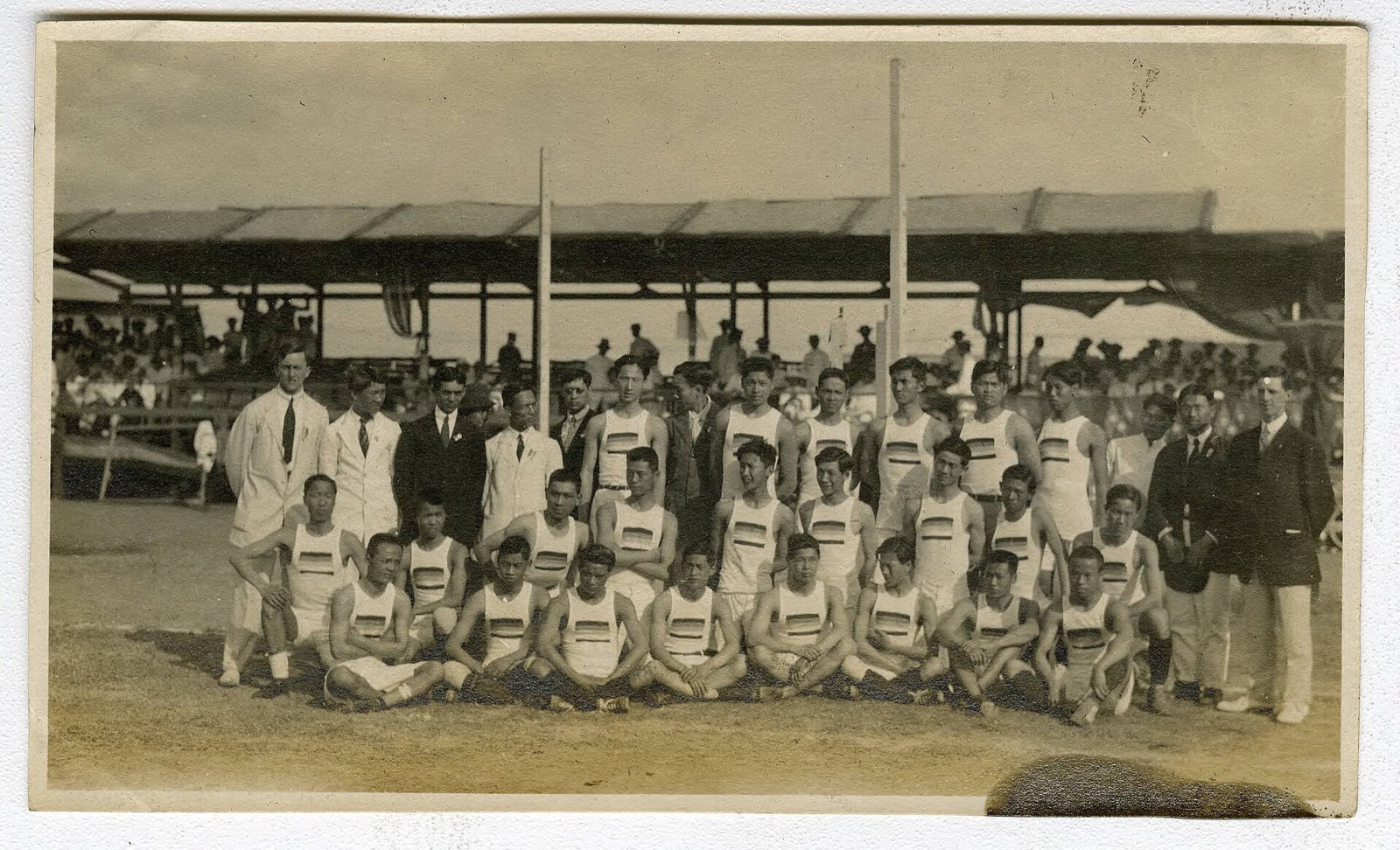
Above: the Chinese team at the first Far Eastern Championship Games, Manila, 1913 (Wikimedia Commons). Most sports spread the slow way, through migration, trade and empire, over generations. Volleyball had a shortcut. Its inventor worked for an organisation with branches in dozens of countries and a mission to export healthy recreation. Within a few decades of that first game in Holyoke, YMCA instructors had carried volleyball across oceans in their luggage, along with rulebooks, nets and that oddly sized Spalding ball.
The first stops
Canada picked it up almost at once, around 1900. YMCA directors introduced it in Cuba, Puerto Rico and across Latin America during the first decades of the twentieth century. In Asia, YMCA physical educators brought it to China and Japan, where it entered school and university sports programmes. Each place adapted it a little, and that's where the story gets interesting.
Manila and the birth of the spike
The single biggest change to the early game came from the Philippines. An American YMCA director, Elwood S. Brown, is usually credited with organising sport there in the 1910s, including volleyball, and with helping to found the Far Eastern Championship Games, a multi-sport competition between the Philippines, China and Japan. The first edition was held in Manila in 1913, and volleyball was on the programme.
Filipino players are widely credited with developing the attacking pattern that defines modern volleyball. One player lifts the ball high near the net (the set), and a teammate leaps and smashes it down into the opposing court. In the Philippines this attack became known as the bomba, "the bomb." Before that, the game was mostly about keeping the ball going. After it, volleyball was about winning the point.
Holyoke gave volleyball its net. Manila gave it its punch.
Asian variations
Not everyone played Morgan's version. In parts of East Asia, the game was played for decades with larger teams, nine players and later twelve or more, arranged in fixed rows without rotation. That style travelled to North America with Chinese immigrants, which is how New York's Chinatown ended up with a volleyball tradition of its own. We tell that story in Nine on a Side. Japan played nine-a-side for many years too, before switching fully to the six-player international game after the Second World War.
The First World War
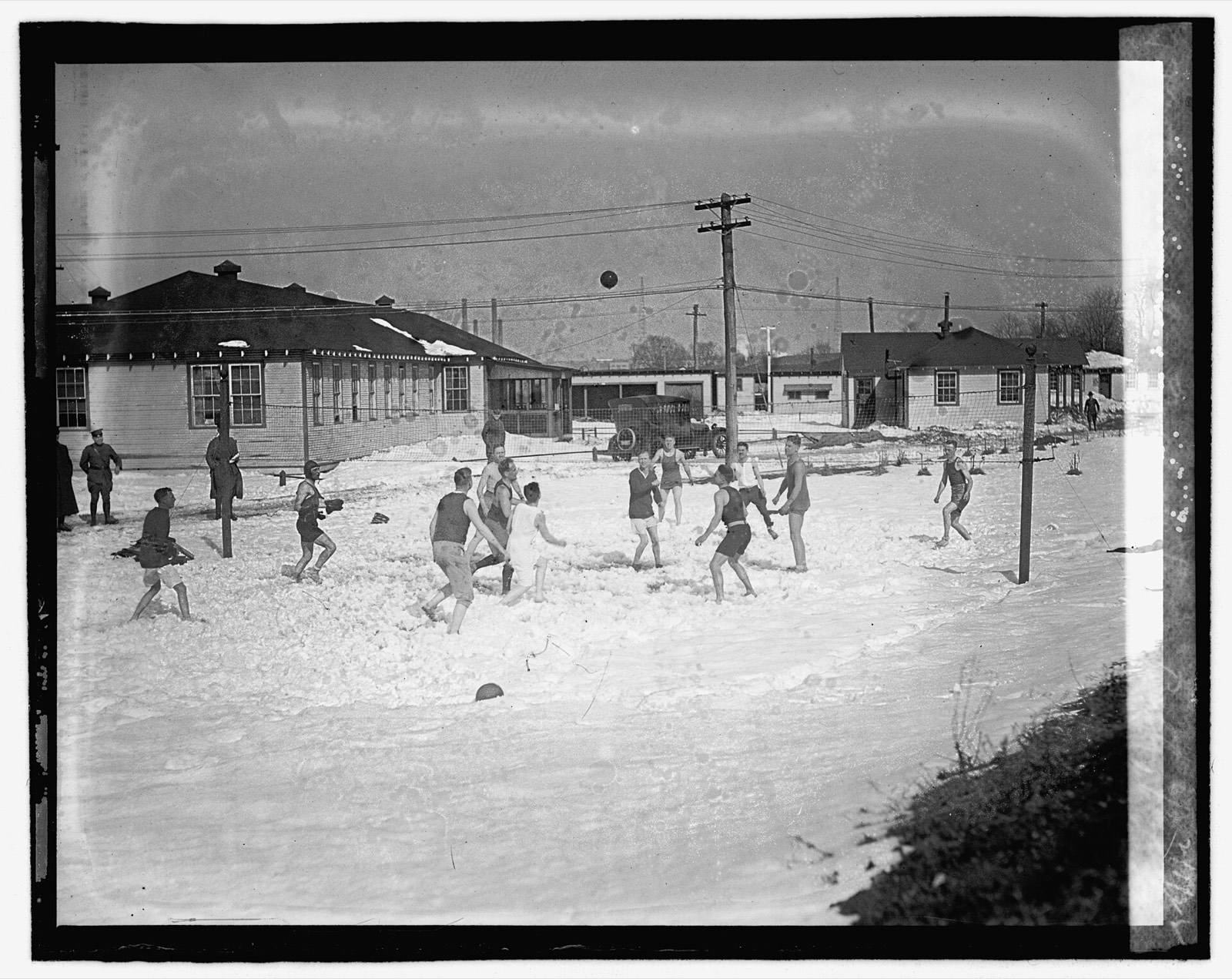
The war spread the game faster than any missionary could. The YMCA ran recreation programmes for American soldiers in France and shipped huge quantities of sports equipment, and volleyball was ideal for camps: cheap, portable and playable by a crowd. Soldiers from many countries saw Americans playing it behind the lines. When they went home, some took the game with them.
After the war came the Inter-Allied Games of 1919, held near Paris for soldiers of the Allied armies. Volleyball featured, and Elwood Brown, the same man who'd organised sport in Manila, was among the organisers. The sport now had an international stage.
Eastern Europe becomes the powerhouse
Between the wars, the game took root powerfully in the Soviet Union, Czechoslovakia, Poland, Bulgaria and the Baltic states, often through workers' and student sports clubs. These countries treated volleyball seriously, with coaching systems, leagues and tall, athletic players. By the 1940s they were the best in the world.
1947: the FIVB
A truly international sport needs international rules. In April 1947, representatives of fourteen national federations met in Paris and founded the Fédération Internationale de Volleyball, the FIVB. A Frenchman, Paul Libaud, became its first president, and he held the post until 1984.
Things moved quickly after that:
- 1948: the first European Championship for men, in Rome.
- 1949: the first men's World Championship, in Prague. The Soviet Union won.
- 1952: the first women's World Championship, in Moscow. The Soviet Union won again.
- 1964: Olympic debut in Tokyo, the subject of one of our favourite stories.
A sport with no single owner
What strikes us most about this period is how widely the credit is shared. An American invented the game. Filipinos gave it its signature attack. Asian communities kept alternative versions alive. Europeans built the competitive structure and the first great teams. Today Brazil, Italy, Poland, the United States, Japan, China, Türkiye and Serbia are all among the world's best. It's one of the few global sports whose story no single country can claim.