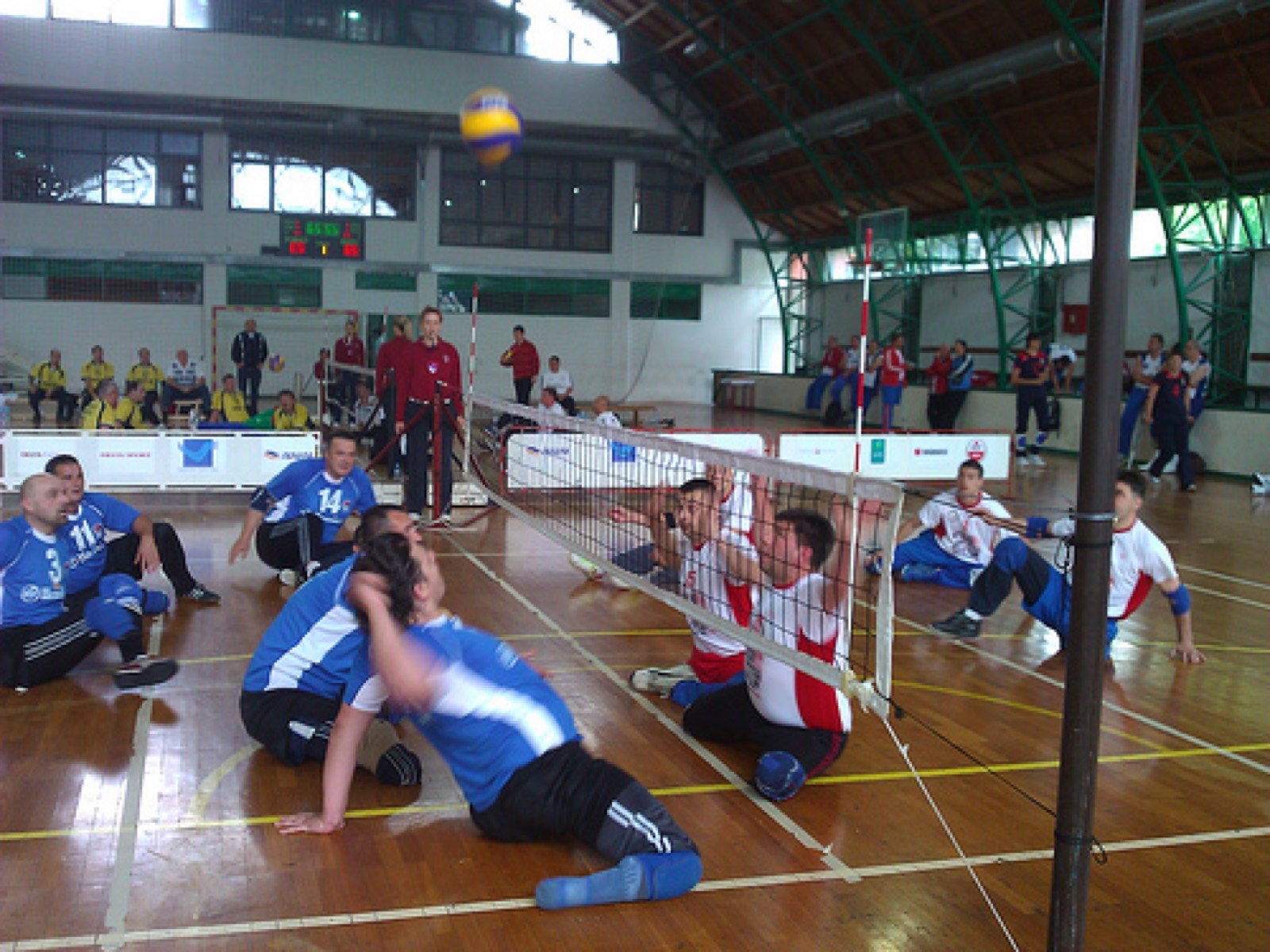
Above: sitting volleyball, a Paralympic sport since 1980 (photo CC BY 2.0). Ask a group of New Yorkers what volleyball looks like and you'll get very different answers. A college fan pictures a packed arena and six tall players. A Rockaway regular pictures two people in the sand. Someone from Chinatown pictures nine men in rows on an asphalt lot. A veteran might picture a team sitting on the floor with a net barely a metre high. They're all right. Volleyball has quietly split into a family of games, each with its own rules and culture.
A quick comparison
| Type | Players a side | Court | Net (men / women) | Big stage |
|---|---|---|---|---|
| Indoor | 6 | 18 × 9 m | 2.43 m / 2.24 m | Olympics since 1964 |
| Beach | 2 | 16 × 8 m, sand | 2.43 m / 2.24 m | Olympics since 1996 |
| Sitting | 6 | 10 × 6 m | 1.15 m / 1.05 m | Paralympics (men 1980, women 2004) |
| Nine-man | 9 | Larger than indoor | Varies by event | North American Chinatown tournaments |
| Snow | 3 (plus a sub) | Snow court | As beach | FIVB snow events |
| Grass | 2–6 | Lawn | Varies | Community & national grass events |
Figures are the commonly published standards. Always check the rulebook of your own league or event.
1. Indoor volleyball
The classic. Two teams of six play on a hard court divided by a net. Each team gets three touches to return the ball, players rotate clockwise after winning back the serve, and specialists dominate: setters, outside hitters, middle blockers, opposites and the libero in a different-coloured shirt. Matches are best of five sets, the first four to 25 points and a deciding fifth to 15. This is the version played in schools, colleges and pro leagues, and at the Olympics since 1964. Curious how rotation works? Try our Rotation Coach.
2. Beach volleyball
Two players, no substitutes, no coach on the court and nowhere to hide. The court is smaller (16 by 8 metres) and the ball softer, but the sand makes every jump harder. Players switch sides regularly to share the wind and sun. Partners communicate with hand signals behind their backs before each serve. Beach volleyball joined the Olympics in 1996, and you can read its full story in Sand Between the Toes.
3. Sitting volleyball
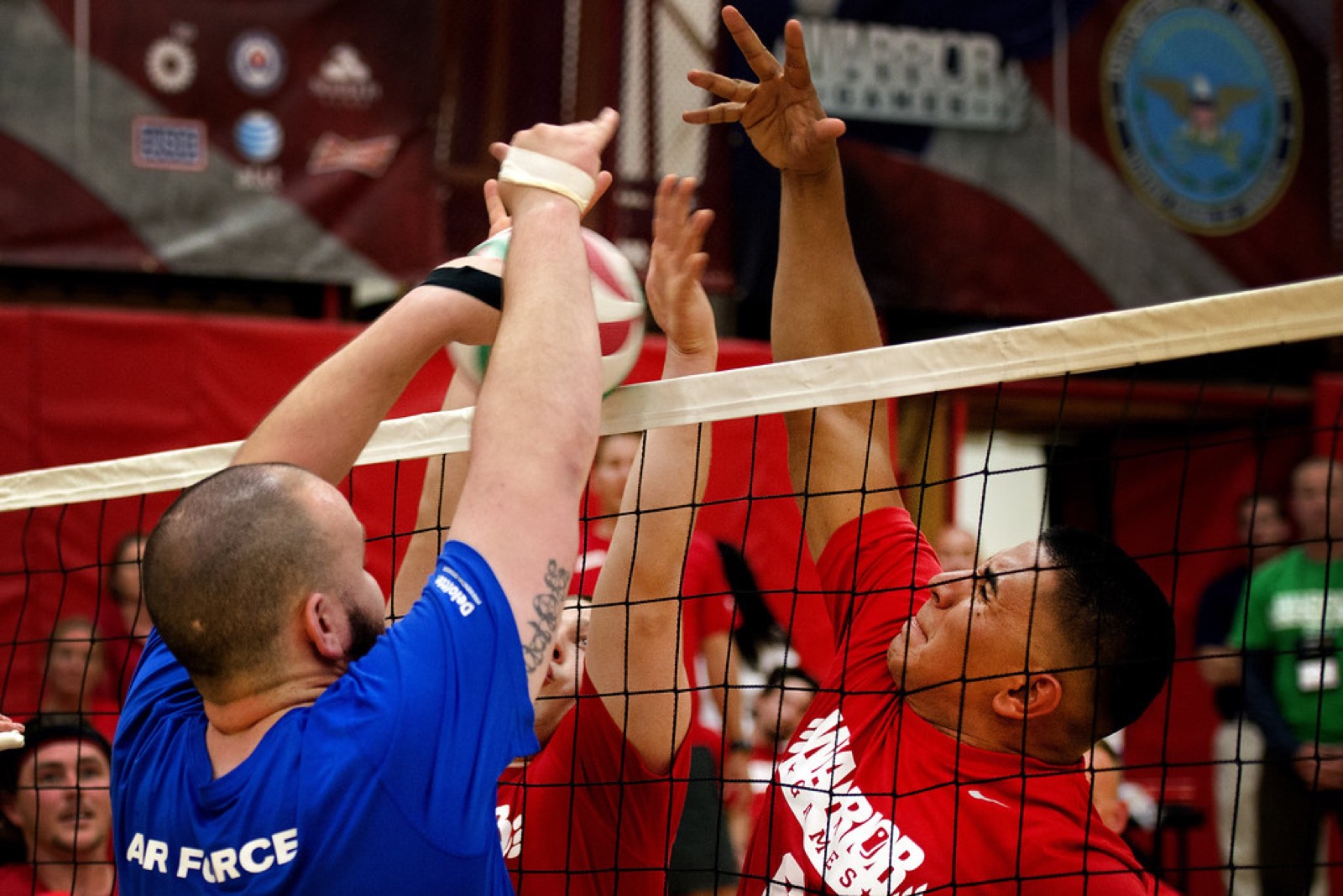
Played with players seated on the floor, with the net lowered to just over a metre. One rule defines it: when playing the ball, a player's pelvis must stay in contact with the floor. The court is small and the ball moves astonishingly fast, so rallies are frantic. It developed in the Netherlands in the 1950s, combining volleyball with a German game called sitzball. It has been a Paralympic sport for men since 1980 and for women since 2004. Iran's men and the United States and China's women have been among the dominant teams. It's also widely used in military rehabilitation programmes.
4. Nine-man volleyball
Nine players a side, arranged in three rows of three, with no rotation: each player keeps a fixed position and job. The ball may touch the net during play, and the game has its own rhythm and tactics. Nine-man came to North America with immigrants from the Toisan (Taishan) region of southern China and survives today mainly through the North American Chinese Invitational Volleyball Tournament. New York is one of its homes. We give it a whole story: Nine on a Side.
5. Snow volleyball
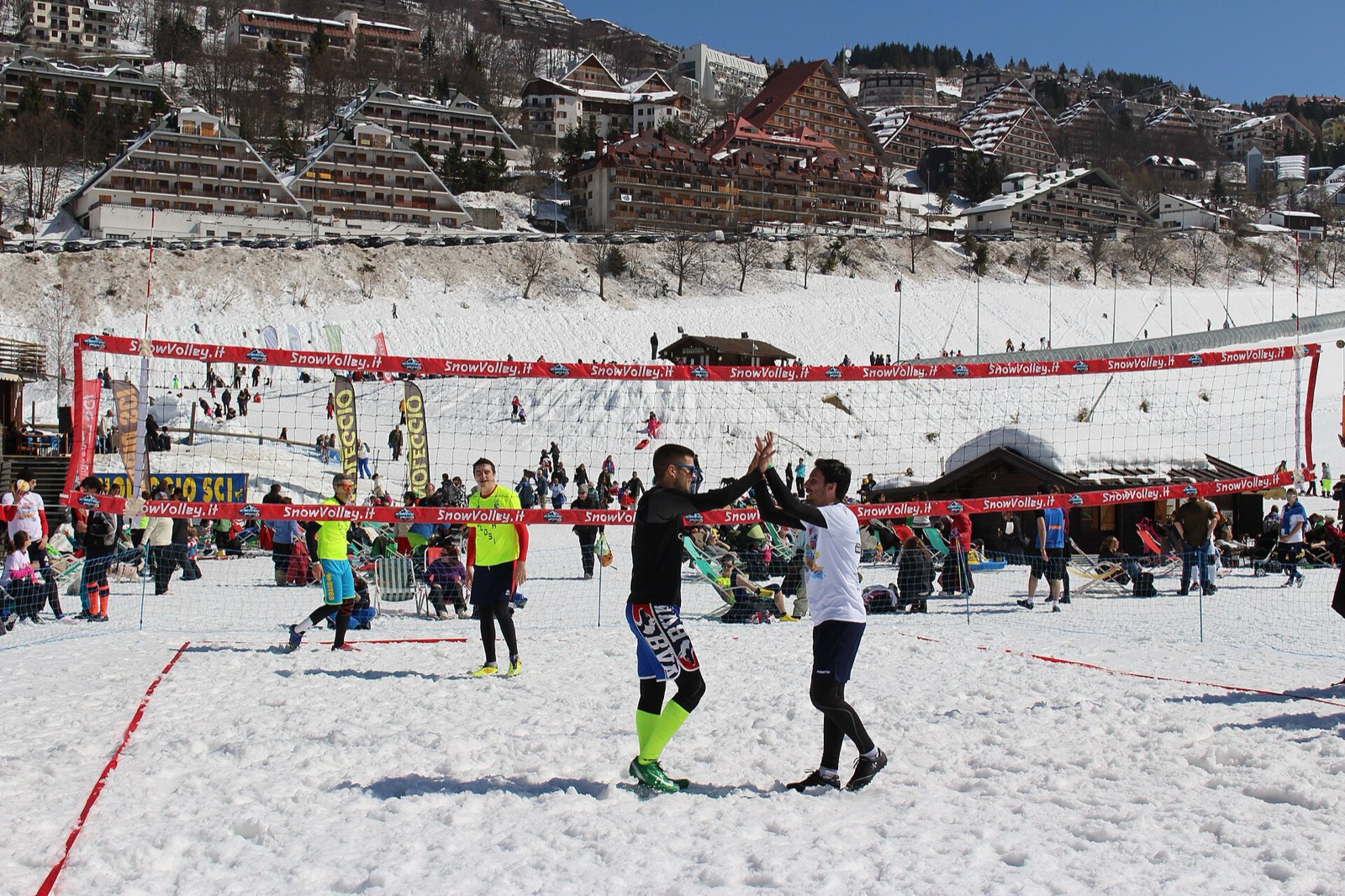
The newest member of the family. Three players a side (with one substitute) play on a court of packed snow, wearing football-style boots with studs for grip and plenty of layers. It began as an informal winter game in Austria in the late 2000s and was later taken up by the European federation and the FIVB, which have organised international snow events since the mid-2010s. The longer-term dream for its supporters is a place in the Winter Olympics.
6. Grass and park volleyball
The version most of us actually play. Grass doubles, triples and fours have their own tournaments, especially in the American Midwest and Northeast, and the governing bodies have started paying attention. USA Volleyball held its first Adult Grass National Championship in Nashville in late 2026 (see News). Then there are the countless backyard and picnic games with a sagging net and flexible rules. Purists may sniff, but this is how most people fall in love with the sport.
A few cousins
- Wallyball, played on an enclosed racquetball court where the ball can be played off the walls.
- Footvolley, from Brazilian beaches, which is volleyball played with football skills (no hands).
- Sepak takraw, a Southeast Asian kick-volleyball with a rattan ball and spectacular bicycle kicks. It's older than volleyball and has its own separate history.
So, how many types are there?
Officially, two at the Olympics, one at the Paralympics and a handful more with international or national competitions. Unofficially, as many as there are nets strung between two poles. What unites them all is Morgan's original idea: a net between two teams, a ball that must never be caught, and the shared panic of keeping it off the floor.